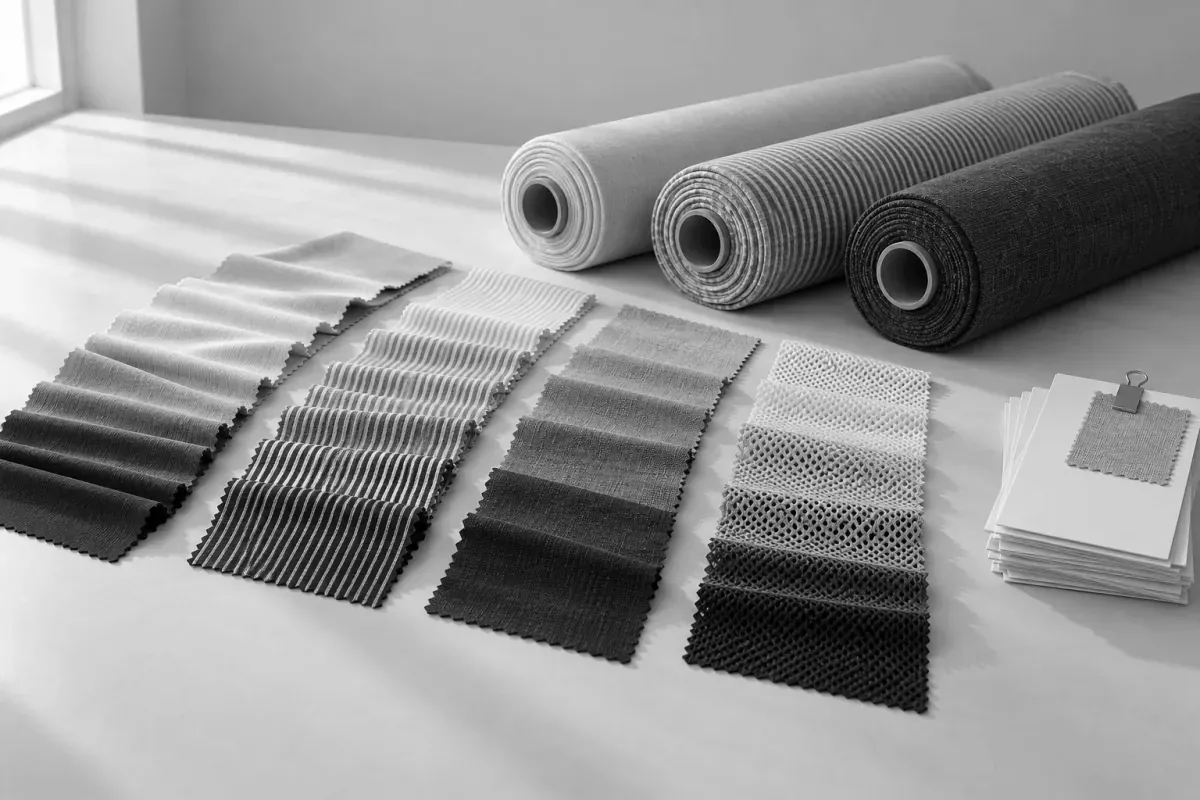
Fabric minimums attach to the color and the dye lot, not the style. Mills dye fabric by the lot, not by the garment, so a custom color has to clear the mill’s minimum on its own, and every style cut from that fabric in that color counts toward it. A minimum cannot be split across colors. One color can be shared across styles.
That makes custom color a line-planning decision, not a style decision. On its own, a single style has to carry the full minimum for every custom color it uses. A line of 8 or more styles a season can carry several custom colors, if the color story is built around shared fabrics before the tech packs lock each style to its own fabric. The bigger the line, the more the minimums reward planning and punish deciding one style at a time.
This post covers how the minimum works, what custom color minimums look like in practice, and the sequence we run to plan color across a line. For the full sourcing process, see our fabric sourcing guide. For why factory minimums differ by country, see why cut and sew MOQs are higher outside China.
Why the minimum lives on the fabric
A dye lot is one batch, one recipe, one color. The mill’s minimum is the yardage that makes running that batch worth the setup. Three things follow from that.
- A minimum cannot be split across colors. Two colors are two dye lots and two minimums. Half the minimum in each color meets neither.
- One color can be shared across styles. The mill does not see a short, a liner or a jacket. It sees yardage of one color on one fabric.
- The color is bound to the fabric. The same navy on two different fabrics is two lots, two lab dips and two minimums. Sharing works only when the fabric is the same too.
Trims work the same way. Dyed-to-match elastic, mesh and labels carry their own minimums, set by the supplier that makes them, and they sit underneath the fabric minimum. A line can clear the body fabric and still get held up by a waistband.
What custom color minimums actually look like
These are the custom color minimums we run into across categories. Each one is per color.
| Component | Custom requirement | Minimum | What it took to meet it |
|---|---|---|---|
| Body fabric, single style | Custom-dyed navy | 850 pieces per color, with a $300 dye surcharge below it | Pooled with the same dyed navy used for inner shorts on 3 other styles |
| Mesh | Dyed to match the body fabric | 500 pieces | The dye house dyed sample yardage, but production yardage needed the full 500 |
| Elastic | Dyed to match | 3,000 yards | Roughly $1 more per unit removed the minimum |
| Heat-transfer size label | Custom color | The label supplier’s color minimum | The fit sample went out with a substitute label, so fit and workmanship were approved first |
In every row, getting under the minimum cost something: a surcharge, a per-unit upcharge, a refusal to dye production yardage, or a substitute trim in the sample. Below-minimum orders cost money. They do not get waived.
Stripes carry their own minimums too. A custom-color yarn-dyed seersucker stripe needs 2,150 pieces on one style, and a knitted striped elastic needs 300 to 500 pieces for bulk. A stripe only pools with other styles that use the same stripe.
Pooling: how one color carries across styles
The custom navy that needed 850 pieces on a single style cleared the mill’s minimum because the same dyed navy was already in the line as the inner short on 3 other styles. Combined yardage met the mill’s number. No surcharge, and no compromise on the color.
Pooling works with stock colors too. A lounge and intimates brand put 4 styles (a brief, a lounge pant, a cowl neck top and a tank) on the same fabric in stock colors and ordered them at the same time. The fabric was bought once, against one minimum, instead of each style paying for its own.
The work is mapping the color story across the line early, before each style’s fabric is locked in its tech pack. What we look for:
- Hidden overlap. Liners, inner shorts and other secondary components can share a dyed color with a body fabric that needs the volume.
- Colors that live on one style. A custom color on a single style carries the whole minimum alone. Find it a second and third style, or make it a stock color.
- Base fabrics that run across categories. In a golf line for women and men, put the women’s and men’s polos on one performance knit and a custom color clears its minimum on both together, plus any skort or layer cut from the same knit. Activewear works the same way: leggings, shorts and bras cut from one base fabric pool by default.
- The PO window. Pooling only works if the styles are ordered together. Styles that share a fabric and color go on the same PO window, or the yardage gets bought twice.
Our performance fabric sourcing guide covers how the base-fabric choice sets the minimum on technical knits.
Stock vs custom, decided style by style
Custom color does not have to be all or nothing inside a style. The better decisions get made color by color.
A brand developing a style in a custom white and a custom stone held the white rather than buy the full minimum, and asked us to source a stock white instead. For the stone, it committed: it bought the minimum, used part of it for SMS and held the rest for production.
Sampling yardage is where that commitment pays off. The factory flagged that 30 meters of sample yardage would carry a $300 surcharge, and recommended buying 300 meters once the lab dip was approved, enough to cover SMS and production together. The surcharge goes away, the SMS come from the same dye lot as bulk, and the samples buyers see match what ships.
Our rule of thumb: if a brand has asked for dyed-to-match and its planned quantity meets the minimum (for example, 500 units per color), we work to achieve the custom color before suggesting a stock alternative. Switching midstream adds confusion on all sides.
Custom color earns its minimum when:
- The planned quantity in that color meets the mill minimum on its own, or pools to it with other styles on the same fabric.
- The color carries across seasons or styles, so the dyed yardage is not a one-style bet.
- A stock color cannot get close enough to the standard.
- The trims in that color (elastic, mesh, labels) clear their own minimums too.
- There is time to approve lab dips before SMS yardage has to be bought.
A stock color is the smarter call when the color sits on a single style below the minimum and cannot pool, when it is a one-season accent, or when the surcharge to go below the minimum costs more than the color is worth to the line.
Where small-batch dyeing and spec gaps bite
Going smaller does not fix it
The obvious workaround to a mill minimum is a small dye house that runs short lots. We have watched that fail. Small dye houses produced poor results on navy, and again on a light blue, for the same brand. The fix was not going smaller. It was pooling enough volume across the line to reach the main mill’s minimum.
The fabric limits the color
Color is limited by the fabric, not just the order size. A performance lifestyle brand needed one navy to match across a printed ground and a solid legging fabric. The fiber composition of one fabric limited which navy the mill could reach, so we compared the lab dips from both fabrics side by side under D65 light before approving either. After lab dip approval, custom weaving took 12 days.
When one color has to run across fabrics with different fiber content, approve the lab dips together, under the same light, so the shade is set by what both fabrics can reach. Shade approval under controlled light is part of how we run quality and compliance on every program.
Spec what exists
A tech pack specified 290 and 310 GSM. The mill could only source 240 and 260 GSM. The weights a mill can actually produce are a constraint on the line in the same way its minimum is. Spec what exists, or budget for development.
How we plan color across a line
This is the sequence we run in product development for a multi-season line, before any fabric is bought:
- Map every style to its fabric. Body, lining, liner and trims, style by style, from the tech packs.
- Group styles by shared fabric and color. This is where the pooling shows up.
- Get mill minimums per color. For every fabric and every trim that needs a custom color, including elastic, mesh and labels.
- Decide custom vs stock per color. Color by color, against the checklist above.
- Approve lab dips before SMS and production yardage. Side by side under D65 wherever one color runs across more than one fabric.
- Buy SMS and production yardage together where possible. One dye lot, no sampling surcharge, and samples that match bulk.
- Place the styles that share a fabric on the same PO window. The yardage is bought once against one minimum, and production cuts from one lot.
When a custom trim holds up a sample, do not hold the sample. Send the fit sample with a substitute, as with the heat-transfer label above, so fit and workmanship get approved while the custom trim catches up. The golden sample then carries the final trim.
Plan the color before the PO
If you’re planning color across multiple seasons and want the fabric minimums worked out before you commit, tell us about your line.