

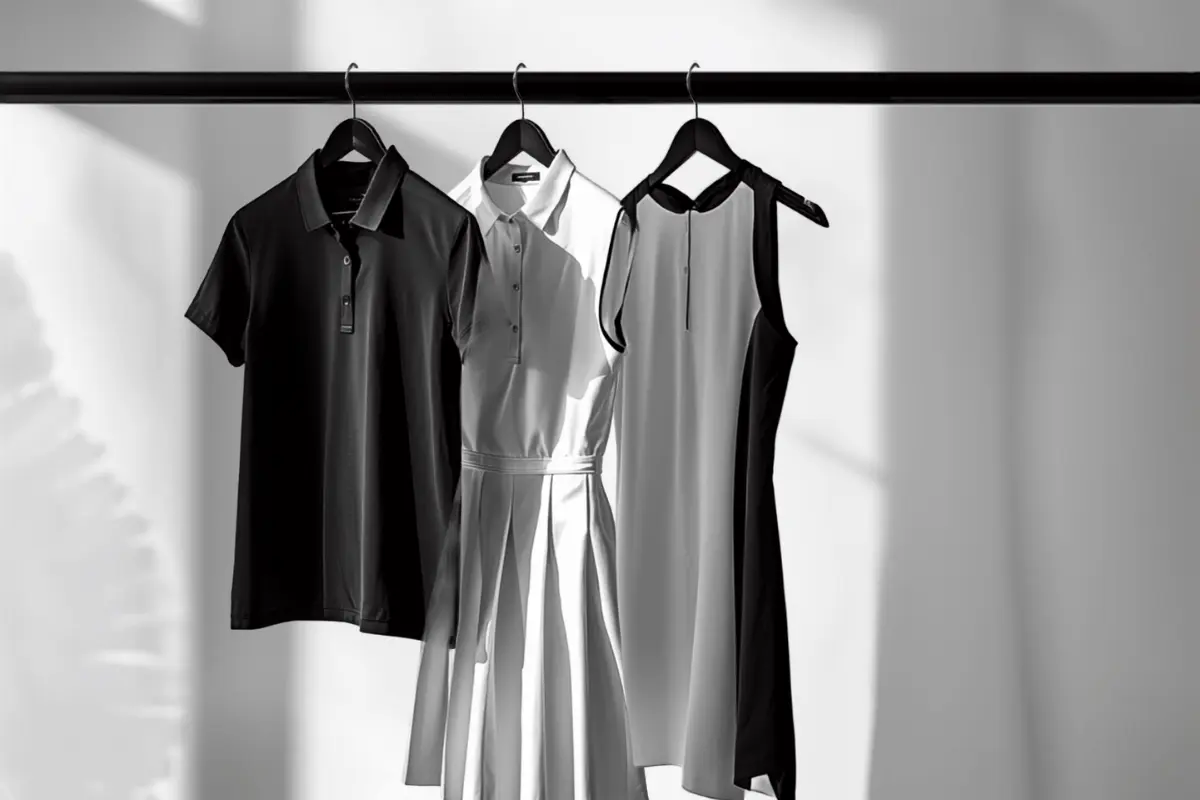
Ask any woman who plays seriously what the apparel options used to look like and you tend to hear the same complaint: cuts borrowed from menswear, ill-fitting polos, loud prints, and very little that actually performs on the course while looking like something you'd choose to wear. That gap is exactly why a new generation of women's golf brands is being built — and why manufacturing women's golf apparel well is a genuinely different discipline than producing the men's equivalent.
If you're a founder developing a women's golf line, this guide covers what actually matters when you take a collection from design to production: the styles that define the category, why fit and construction are harder than they look, how to source the right performance fabrics, and the realities of minimums, sampling, and choosing a manufacturer. It's a companion to our guide on sourcing performance and technical fabrics, which goes deeper on the fabric side that underpins everything here.
Quick answer: what makes women's golf apparel manufacturing different?
Women's golf apparel manufacturing differs from men's in four ways. First, the category includes women's-specific silhouettes — skorts, golf dresses, and pieces with built-in shapewear — that require pattern-making and construction expertise most general factories don't have. Second, fit tolerances are tighter, because a women's performance garment has to move, hold shape, and flatter across a far wider range of body shapes than a men's polo. Third, the fabric has to do double duty: technical performance and a premium hand-feel, since this customer is buying on both function and how it looks. Fourth, the buyer and the channel (pro shops, country clubs, direct-to-consumer) reward design distinctiveness, so construction details like seams, zippers, and waistbands carry disproportionate weight. Get those right and you have a garment that performs on the course and survives a season of wear and wash.
The styles that define a women's golf collection
A women's golf line is rarely just polos. The category has its own vocabulary, and a manufacturer should be fluent in all of it.
The skort is the signature women's golf garment — a skirt with built-in shorts underneath. It's also one of the more technically demanding pieces to produce well, because it combines two garments, often uses flatlock or laser-cut seams to avoid chafing and bulk, and has to hold its shape through a full round of movement. A factory that produces skorts casually and one that produces them properly are not the same factory.
Golf dresses, frequently with built-in shapewear, are a fast-growing category. The construction is genuinely complex: a single garment that integrates a performance outer layer, internal shaping, and details like scuba-style zippers and tee holders. Small errors compound — a zipper an inch shorter than spec, a shaping panel that puckers — and they're the kind of mistakes that send founders looking for a new manufacturer.
Performance polos and sleeveless tops are the foundation pieces, where women's fit and collar construction both matter. A women's polo isn't a smaller men's polo; the pattern, dart placement, and proportions are specific to the garment.
Bottoms — pull-on pants, leggings, and shorts — round out most collections and lean heavily on four-way stretch and recovery.
Layering pieces like quarter-zips and lightweight outerwear extend the line into shoulder seasons and complete a wholesale-ready collection.
Why fit and construction are the hard part
The single most common reason a women's golf founder switches manufacturers is fit and construction failures on exactly these complex pieces. It is one thing to make a garment that looks right on a flat table and another to make one that moves, recovers, and flatters on the course.
Three construction details cause the most trouble:
- Seams on skorts and shaped pieces. Flatlock and laser-cut seams reduce bulk and chafing but require specialized machinery and skill. A factory without that capability will substitute a standard seam that looks fine in a photo and fails in wear.
- Built-in shapewear and internal structure. Integrating a shaping layer into a dress or skort is a pattern-making problem first and a sewing problem second. It needs an experienced pattern maker, not just a sample machinist.
- Zippers and closures. A closure spec'd in the tech pack but unachievable on the production line is a classic failure — the sample looks perfect, then the factory reveals it can't hold that tolerance at volume. The time to discover this is during sampling, not after a deposit.
The practical takeaway: for women's golf, the quality of the factory's pattern maker matters more than almost anything else. The best technical factories employ a senior, in-house pattern maker who can deconstruct a reference garment and rebuild it to spec. That capability is what lets a brand reduce sample rounds and trust that the production run will match the approved sample.
Sourcing the right performance fabric
Women's golf apparel has to perform and feel premium at the same time, which makes fabric selection unusually consequential. The fabric needs four-way stretch and recovery so a skort or dress holds shape, moisture management for play in heat, and often UV protection — while still delivering the hand-feel that justifies a premium price.
Most performance knits for this category are synthetic or synthetic-blend, and the deepest supply of them sits in China, where technical mills, finishing, and decoration capability are concentrated. Premium cotton-blend pieces for a more heritage aesthetic can route to Peru, and high-end sublimation and technical outerwear to South Korea. The right answer is usually to route each style to the country best suited to its fabric rather than forcing a whole collection through one factory.
A note on sourcing outside China specifically for women's performance pieces: it's possible, but for synthetic and performance fabrics it usually means importing the fabric to the production country, which only pencils out at higher volumes. For most scaling women's golf brands, the technical-fabric supply chain is deepest where the mills are. Our performance fabric sourcing guide covers the specifications — blend ratios, GSM, stretch and recovery, finishes — to lock down before committing to a run.
MOQs, sampling, and lead times for women's golf
The production realities for women's golf apparel mirror the broader category, with a few specifics worth planning around.
Minimum order quantities for custom women's golf pieces typically start around 100 units per colorway at the most flexible factories. That's achievable for an emerging brand, and the practical lever for managing it is consolidating colorways or building a collection around shared base fabrics so you're not hitting a separate minimum for every style.
Sampling should be budgeted at two to three rounds per style, roughly 30 days each once fabric is selected, with fabric swatch sourcing adding about a week up front. Complex pieces — dresses with shapewear, skorts with laser-cut seams — are the ones most likely to need the extra round, so build the calendar accordingly.
Reducing sample rounds is where an existing product helps enormously. If you already produce a dress or skort you're happy with, providing it as a reference sample lets a capable factory deconstruct it, match the fabric, and incorporate tech-pack changes — cutting iterations versus starting from a flat tech pack alone.
Lead times generally run 20–30 days for samples and 40–70 days for production, with imported or custom-developed fabric being the main variable that pushes timelines longer.
Choosing a manufacturer for women's golf apparel
Beyond the table-stakes questions you'd ask any apparel manufacturer, women's golf brands should weight a few criteria more heavily.
- Pattern-making depth. Ask specifically about the factory's pattern maker and their experience with skorts, dresses, and shaped pieces. This is the capability that determines whether your complex styles come out right.
- Category track record. A manufacturer that already produces for women's golf or women's performance brands understands the fit and construction expectations. General cut-and-sew experience is not the same thing.
- Fabric sourcing capability. Confirm they can source — or have ready access to — the performance knits your collection needs, and that they'll send swatches before you commit.
- Communication and oversight. Many founders switch manufacturers not because of price but because of communication breakdowns and quality drift. A partner who manages the factory relationship, provides a single point of contact, and maintains on-the-ground oversight removes the 2 a.m.-messages problem that pulls founders away from growing the brand.
Common questions about women's golf apparel manufacturing
Who manufactures women's golf apparel?
Women's golf apparel is produced by specialized performance-apparel manufacturers and sourcing partners with pattern-making and technical-knit expertise — not general cut-and-sew factories. The category requires experience with women's-specific styles like skorts and golf dresses, four-way stretch performance fabrics, and construction details like flatlock seams and built-in shapewear. MakeMine manages production for women's golf brands across a vetted factory network in China, Peru, and South Korea, routing each style to the factory best suited to its fabric and construction.
Can I manufacture golf skorts and dresses at low minimums?
Yes. Minimum order quantities for custom women's golf pieces typically start around 100 units per colorway at the most flexible factories. Consolidating colorways and building your collection around shared base fabrics is the most reliable way to keep total minimums manageable as an emerging brand.
What fabric is best for women's golf apparel?
Most women's golf performance pieces use four-way stretch synthetic or synthetic-blend knits with moisture management and, often, UV protection — chosen to balance performance with a premium hand-feel. The exact blend depends on the garment: a structured skort, a shapewear dress, and a lightweight polo each call for a different construction. Premium cotton blends are an option for more heritage-styled pieces.
Why do women's golf brands switch manufacturers so often?
The most common reasons are fit and construction failures on complex pieces (skorts, shapewear dresses), closures that can't be held to spec at production volume, and communication breakdowns with overseas factories. Brands typically look for a partner once they've completed a production run, understand the pain points, and want to hand off factory management to focus on growing the brand.
Do I need a tech pack to start, or can I use a reference garment?
Both work. A complete tech pack is ideal, but a reference garment you already produce and like can stand in — a capable factory will deconstruct it, match the fabric, and apply your changes, which often reduces the number of sample rounds needed.
Bringing it together
Manufacturing women's golf apparel well comes down to respecting what makes the category distinct: women's-specific silhouettes that demand real pattern-making skill, construction details that fail quietly when a factory cuts corners, and fabrics that have to perform and feel premium at once. Choose a manufacturer with genuine pattern-making depth and category experience, lock your fabric and construction specs before you commit, and build enough sampling into the calendar to get the complex pieces right.
That's the work MakeMine does for women's golf brands. We route each style to the right factory across our network, develop custom performance fabrics, and manage the factory relationship so founders can focus on design, sales, and growth rather than 2 a.m. messages and quality drift. To see our full approach to the category, visit our golf apparel manufacturing page.
Ready to develop your women's golf collection? Get a free quote from our trusted factory network. There's no commitment and no fee required to get pricing.



.png)